Great Lakes Growers’ Blueprint for Profitability
March 17, 2026
Take a stroll through Great Lakes Growers’ 2.75-acre greenhouse operation in Burton, Ohio, and it’s like walking through time. Managing facilities ranging in age from six to 13 years old, Director of Growing Renato Zardo doesn’t just grow lettuce. He fine-tunes a production strategy that adapts to each environment’s strengths to maintain consistent yield and profitability.
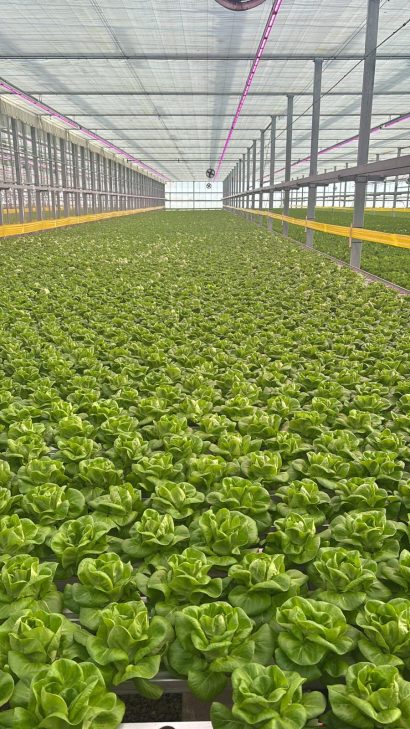
“I have five different growing environments that give me five different crops even though they’re the same variety,” he says.
Getting the best possible yield in all of his greenhouses is easier said than done. In addition to mastering the different growing conditions of each facility, Zardo must be intentional about upgrades as well as retrofits.
Production planning
To navigate these different growing conditions, Zardo has developed a strategic approach to production planning. The wide range of technology and equipment across Great Lakes Growers’ greenhouses means he must be especially careful when deciding where to grow each of his lettuce varieties.
The lettuces grown in each greenhouse are determined by the level of tech, light intensity, and glass used in the facility. “That’s the difference between finishing a crop in 35, 38, or 40 days,” Zardo says.
Crop placement is based on sensitivity. The most delicate and profitable lettuces are grown in the high-tech greenhouses while the hardier, less profitable varieties are grown in the low-tech facilities.
“Let’s say I have butter lettuce and cut lettuce growing together,” Zardo says. “The butter lettuce will drive the greenhouse because it’s sensitive to tipburn.”
While he can afford to have a smaller yield on cut lettuce, he cannot afford to lose his butter lettuce crop entirely. So, he must adjust the lighting recipe to be more suitable for butter lettuce than cut lettuce.
“Higher yield on the cut lettuce wouldn’t make sense if I lost the butter to tipburn,” he explains.
Be intentional with technology upgrades
Beyond deciding what to grow where, Zardo must determine the right time to upgrade his facilities with new technology and equipment.
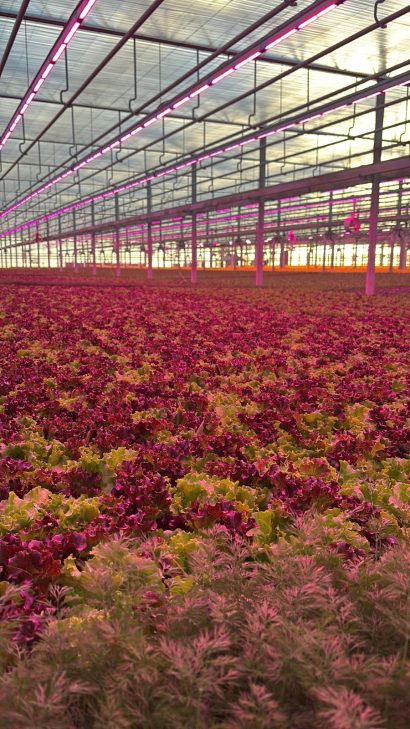
Great Lakes Growers’ careful, strategic approach to production planning extends to technology upgrades. The operation has made minimal updates to each of its greenhouses, only investing in new tech when it makes sense. But when it builds a new greenhouse, it makes sure the structure has the highest level of tech available.
Problems tend to emerge when growers rush into expansion and invest in new tech without proving its value. This is another instance where Great Lakes Growers’ decision to grow slowly has worked in its favor.
“We have seen growers grow too fast in an industry that’s not doing that well,” he says. “We grow slowly, with certainty that our expansions will be very related to our market.”
But this decision hinges on how practical the upgrade is. When it comes down to it, Great Lakes Growers is a lettuce-growing operation. Leafy greens aren’t a high value crop, so the profit margins aren’t very high.
Ultimately, Zardo says, he needs to remember that his job is growing lettuce. Investing in expensive new tech rarely has a major ROI in greenhouse production.
Reading the Plant First
No matter how old a greenhouse is or advanced the technology inside of it, Zardo says success ultimately comes down to reading plants correctly.
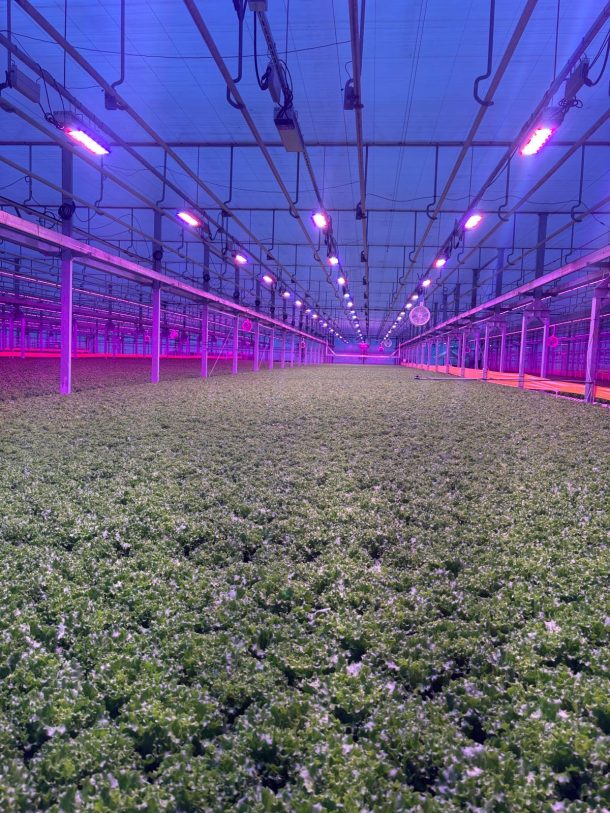
“If a plant can’t handle your environment, it will let you know,” he says. “You have to learn how to read your plant. It will tell you if your environment is too much, not enough, or just right.”
There is no shortcut for grasping this concept. It takes time to figure out how a greenhouse works and what plants want – but every greenhouse and plant are different. Once a grower masters the conditions of their facility and how to grow their crops, that’s when the magic happens.
“You’re not going to get the hang of growing during your first or even second year of it,” Zardo says. “Growing is a science, and it takes time to understand it. There is no shortcut for experience.”
In the spring, Great Lakes Growers will add another acre to its greenhouse operation — the next chapter in its walk through time.
While this greenhouse expansion will be equipped with cutting-edge technology, Zardo’s approach remains the same: adapt to each greenhouse, prioritize the crop, and only expand when it makes sense. This plant-first strategy has kept Great Lakes Growers profitable while newer, tech-focused operations struggle to find their footing.
OHP Expands Sales Team with New Hire and Internal Promotion
March 12, 2026
RESEARCH TRIANGLE PARK, North Carolina | March 12, 2026 – AMGUARD™ Environmental Technologies (“AMGUARD”), the specialty markets division of AMVAC Chemical Corporation, a wholly owned subsidiary of American Vanguard Corporation (“AVD”), today announced two key additions to its OHP sales organization: the hiring of Alfredo Lara as Technical Sales Manager and the promotion of Joe Grippi to Key Accounts Manager.
Alfredo Lara joins OHP as Technical Sales Manager, covering California, Nevada, and Arizona. A native of California’s Central Coast and now based in the Central Valley, Lara holds a B.S. in Plant Health from California State University, Fresno. He brings extensive experience in field research, account management, business development, and independent consulting, with a career focused on market development, product launches, and customer support. In his new role, Lara will be responsible for building and maintaining customer relationships, driving demand with distribution and end-user accounts, and supporting OHP’s growth in the greenhouse and nursery segments across his territory.
“We are excited to welcome Alfredo to the OHP team,” said Frank, Director of Sales for OHP. “His deep roots in California agriculture and hands-on experience across multiple areas of the industry make him an ideal fit for this Western territory.“
Joe Grippi has been promoted to Key Accounts Manager, joining fellow KAM Duffey Clark in managing OHP’s national distributor relationships. Together, the two will divide responsibilities across key accounts, working to develop and execute strategic commercial plans that drive growth across OHP’s Nursery, Greenhouse, CEA, and Cannabis markets. Grippi joined OHP as Southeast Technical Sales Manager and has demonstrated a strong ability to build relationships and drive results. He brings a distinguished industry background, having previously served as Key Account Manager for Specialty Products at UPL Environmental Solutions and, prior to that, as Business Development Key Account Manager at Bayer Environmental Science / Envu, where he spent 22 years. He began his career at Elf Atochem and American Cyanamid.
“Joe’s promotion reflects both his exceptional performance since joining OHP and the confidence we have in his ability to strengthen our key distributor partnerships nationally,” said Frank Fornari, Director of Sales for OHP. “Together with Duffey, we now have a formidable KAM team that is well-positioned to accelerate OHP’s growth across our most strategic accounts.“
About OHP
OHP offers a comprehensive portfolio of conventional and biological solutions, including fungicides, insecticides, herbicides, plant growth regulators, and biosolutions, designed to meet the evolving needs of greenhouse, nursery, and CEA markets across the United States and Canada.
The Untouched Harvest: How Greenswell Growers Is Redefining Lettuce Production with Full Automation
February 10, 2026
In a modest greenhouse spanning less than 1.5 acres in central Virginia, a quiet revolution in leafy greens production is unfolding. Greenswell Growers harvests over 3,000 pounds of lettuce every day — five days a week — with fewer than 15 employees.
Its secret? A level of automation so complete that their retail lettuce travels from seed to supermarket shelf without ever being touched by human hands.
“Everything from planting the seed, to moving through the greenhouse, to controlling the environment, to picking a tray off the line to go harvest, harvesting that crop, packaging it in a tray, and then selling it in the retail store — all of that is automated with robotics and computers,” explained Ben Sword, grower and food safety coordinator at Greenswell.
Half of the company’s workforce operates in the packaging room, while the rest of its staff rounds out the administrative side: from the CEO to marketing and sales. “It’s a really cool business to be a part of,” he said.
Manufacturing Meets Agriculture
At the heart of Greenswell’s operation is the Green Automation system, a mobile gully setup that transforms greenhouse growing into a manufacturing assembly line.
The system uses conveyor belts to move channels — rectangular trays about 2 inches wide by 18 feet long — through every stage of production.
The process begins when these channels are filled with peat moss and pass through an automated seeding machine.
“It’s like a vacuum drum,” Sword described. “There are holes on the outside of the drum, and then the vacuum will pick up one seed at a time and then evenly space them along the channel.“
From there, a robotic swing arm places the newly seeded channels onto one of eight growing lines in the greenhouse.
Each line holds approximately 1,500 channels at any given time, creating a precisely choreographed ballet of lettuce production. The system operates on a simple but critical principle: take one off, put one on.
As workers harvest a mature channel at one end, they must immediately place a newly seeded channel at the germination end. Every time a channel is removed for harvest, all 1,500 remaining channels advance one position toward the harvest end.
The Food Safety Advantage
For Greenswell’s retail trays, complete automation directly translates into enhanced food safety, a topic of concern in an industry that’s had several contamination incidents.
“The main vector of foodborne illness is from humans who are sick,” Sword said.
While Greenswell’s policy prohibits sick employees from working, he acknowledged the risk of asymptomatic transmission: “The less that a human touches any produce is going to be inherently safer.”
And when production is fully automated, the lettuce doesn’t need to be washed. It’s ready to eat straight from the package.
Extending Shelf Life
Lettuce begins cooling in Greenswell’s packaging room before it’s even cut from the channel. After packaging, products move to a 35-40 degree Fahrenheit cooler.
“That immediate cooling even before cutting is a big part of that shelf life increase,” Sword explained. The official shelf life for both Greenswell’s retail trays and its bulk products is 21 days — about a week longer than field-grown lettuce.
But Sword’s tracking reveals even more impressive results. “Sometimes it’ll last one, even two weeks longer than that in your fridge,” he said.
For retail trays that benefit from complete automation, shelf-life performance consistently exceeds that of the already-impressive bulk products.
The wholesale products, packed by hand into two-pound bags by gloved workers following strict food safety protocols, still benefit from the greenhouse environment’s advantages but lack the end-to-end automation of the retail trays.
Growing Driven by Data
Today’s greenhouse growers need to be as comfortable with data as they are with plants.
After studying plant science at Cornell — where Sword met head grower Gus Brennan through the university’s hydroponics club — he spent time in research and development roles, including work at a mushroom materials company conducting bioreactor experiments.
“That taught me so much about data analysis, design of experiments, and general R&D,” he said.
Now at Greenswell, he applies those skills to an operation that’s constantly generating information.
“Because we are a high-tech greenhouse, we collect a lot of data. And data by itself is not useful unless you can analyze it and figure out actionable items from that data,” he said.
One of his current projects involves developing a yield prediction model using machine learning and artificial intelligence. The goal is to better align production with sales demand, a persistent challenge in biological systems.
“It’s a notoriously hard problem because there are so many variables,” Sword admitted. “It’s a tough nut to crack.“
Beyond Efficiency
As the industry continues to mature, Sword sees Greenswell’s approach as part of a broader shift toward food security and supply chain resilience.
“The CEA industry gives us more food security,” he said. “It’s a diversification of the supply chain that is consistent, year-round, and produces a really high-quality product.“
For now, Sword and his small team continue their daily work, which he jokingly calls “servicing the machines.”
“This is how I see the future of our world becoming: the humans exist on the planet just to service the machines and the AI, and they do most of the labor for us, but we have to make sure those machines are working correctly, and they’re getting oil, and they’re getting grease.“
The future has already arrived in this central Virginia greenhouse.
Here, lettuce grows untouched, and a handful of people are proving that agriculture’s next chapter may look more like advanced manufacturing than traditional farming.
Samurai Precision Meets Midwest Horticulture: Inside the Collaboration Driving Grafting Automation
January 9, 2026
At Ohio State, a compact Japanese machine is helping researchers rethink what’s possible with vegetable grafting — and opening new doors for crop resilience, labor savings, and food system innovation.
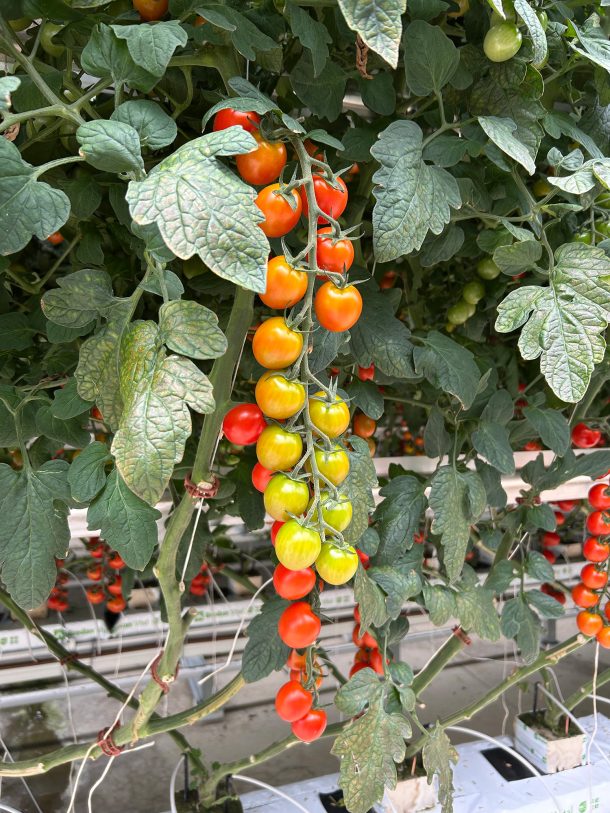
In a quiet greenhouse at The Ohio State University, a compact robot is doing something profound: it’s grafting tomatoes with near-perfect accuracy, and it’s doing it faster than a seasoned human technician.
Developed by Kusakabe Kikai, a Japanese industrial manufacturer new to agriculture, the grafting machine uses a patented side-cutting blade that OSU Professor Dr. Chieri Kubota jokingly calls “samurai-style.”
By cutting laterally, the machine requires significantly less vertical space for the blade to move, allowing for a more compact design.
Growers can also choose their preferred cutting angle before the machine is built, a feature that adds flexibility and customization.
It’s a small-footprint solution with a large impact, promising to simplify a notoriously tedious step in vegetable propagation — and opening up new possibilities that hand labor can’t achieve.
From Osaka to Ohio: How the Partnership Began
The story started in 2016, when Kubota was still at the University of Arizona. During a visit to Osaka, Japan, she was introduced to Kusakabe’s president, who had heard of her work promoting grafting in the U.S. The connection stuck.
Years later, at OSU, she invited the company to join her research consortium and showcase their work in North America. The company donated one of its machines to OSU — currently the only one of its kind in the U.S.
Simple to Operate, Easy to Maintain
“It’s very simple [to use]. It’s pretty much ‘place plants,’ ‘hit button,’ and then ‘get the next set of plants ready,’” said Dr. Jason Hollick, who oversees much of the hands-on research. “Most people are up and running within two hours.“
After it’s clicked, “there’s no difference between experienced workers and beginners,” added Koji Shimada, head engineer of grafting automation at Kusakabe.
Maintenance is equally straightforward. Rather than computer screens displaying error codes, the machine uses a system of indicator lights.
“Based on whatever lights are lit up, you just look and see what that corresponds to,” Hollick said.
And thanks in part to the precise angle and steadiness of the cut, survival rates in OSU trials have reached 100%.
Grafting Speed and Survival Rates
The machine grafts up to 400 plants per hour per Kusakabe’s trials, with 300 per hour being typical. According to Shimada, that’s roughly twice the speed of average human grafters.
Beyond Automation: What Machines Can Do That Humans Can’t
But Kubota’s interest goes beyond automating labor. “I’m most excited about what machines can do that humans can’t do easily,” she said.
For example, grafting earlier in a plant’s developmental stage could improve healing rates and reduce propagation time. Humans can’t reliably graft at those delicate stages, but a machine might be able to.
Lowering the Cost of Grafted Plants for Field Production
While greenhouse tomato producers have embraced grafting for years and have seen yields increase by 15%, field production in the U.S. still lags far behind due to its high cost. Grafted plants require more labor and often suffer losses during the process. Many U.S. nurseries over-seed by up to 40% just to compensate for grafting and germination failure.
Mechanization potentially changes that equation. “We try to lower the loss during the process so the price point comes down,” Kubota said. When that happens, grafting’s value becomes more accessible.
In Asia and Europe, where grafting is more established, Kusakabe’s machine has already been adopted. OSU hopes its U.S. trials can pave the way for wider use here.
They’re even inviting growers to demo the equipment firsthand. “If nurseries want to use our machine to test their plants, just contact us,” Kubota said. “We’re happy to work together.“
What’s Next: New Models and a USDA Research Initiative
According to Shimada, Kusakabe is now developing a lower-cost model and a new version tailored for cucurbits — crops like watermelon and cucumber that typically require more complex grafting techniques. Both are expected within two years.
Meanwhile, Kubota and Hollick are pursuing a USDA planning grant that would unite nurseries, engineers, and researchers around a shared goal: lowering the cost of grafted plants across the board. Partners include Tri-Hishtil in North Carolina, Morning Star in California, and California Masterplant.
The team at OSU envisions a future where mechanized grafting isn’t just faster and cheaper — it’s fundamentally better.
“Grafting gives us a way to quickly adapt to drought, pathogens, and other disease or environmental stress,” Hollick said. “By having more mechanized ability to graft, you increase the [accessibility for growers to] actually use this, economically and efficiently, for more cropping systems.“
Scaling Grafting for Climate Resilience
And with climate volatility, rising labor costs, and mounting crop pressures, that scalability carries big potential.
“I like to see the direction of machine grafting [go] beyond human. So it’s not replacing humans, but [achieving] something new, something special, [only possible] by machine,” Kubota said.
With the help of researchers, growers, engineers, and a small machine wielding a precision samurai blade, agriculture is on its way to reaching those superhuman heights.
Growers interested in testing the Kusakabe Kikai grafting machine can contact Jason Hollick (hollick.4@osu.edu) at Ohio State University’s Department of Horticulture and Crop Science.
A Midwest Proving Ground: Inside Green Legacy’s New Trial Garden
November 19, 2025
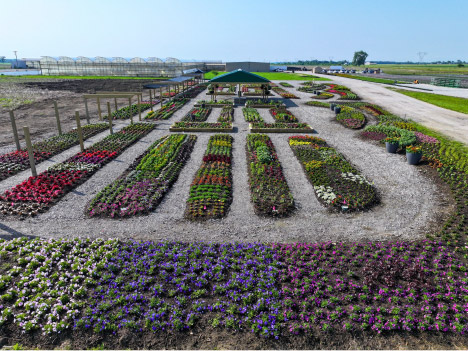
When Green Legacy broke ground on a one-acre trial garden in rural Ohio, they set out to do something different. Few trial gardens are located in the Midwest, and even fewer are built for landscapers. So, they created one, rooted in realistic growing conditions and designed for the people who shape the region’s landscapes.
Launched with a $100,000 budget in partnership with EMI — and with the support of 25 sponsors, EMI staff, and Green Legacy staff — the trial garden in Orient, Ohio, opened its gates to the public on August 15, 2025.
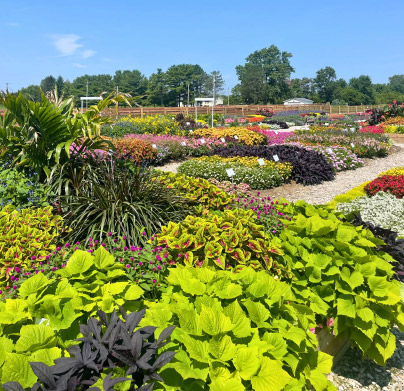
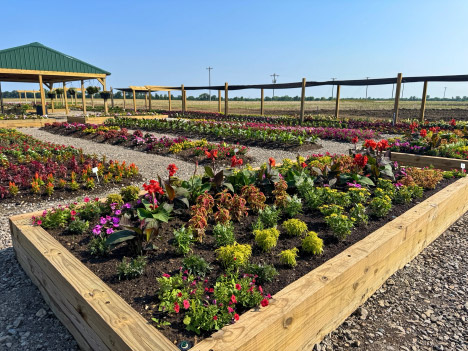
Today, more than 40,000 plants representing over 450 varieties fill the site, arranged not as sterile rows but as a living landscape. Irrigation rains down from overhead, shade structures break the sun, and seating areas invite visitors to linger.
Those were intentional design choices meant to mirror the conditions landscapers work with every day. “It’s not just about making it nice for visitors,” Brill said. “We wanted the setup to look and feel like what landscapers actually deal with on site.“
Green Legacy wanted to create a space that not only tests plants but models what the future of Midwest commercial landscaping could look like. The idea took root months earlier in a conversation between Dan VanWingerden, Owner of Green Legacy, and one of their key customers, EMI.
“They were telling us what they wanted to buy,” said Audrey Brill, Trial Garden Coordinator. “Dan wanted to flip that so we could show them what they need.“
Brill, a recent graduate of Ohio State with a degree in Sustainable Plant Systems, was originally a math major, but switched paths after a general education course in horticulture. “I thought, why be an accountant when I can hang out with plants all day?” Now, as Trial Garden Coordinator, she leads the day-to-day work of the garden with a small team of seasonal help.
A Rapid Rollout with Industry Buy-In
After initial brainstorming in October 2024, the project moved from design to execution in a matter of months. By the end of February 2025, VanWingerden had called 20 breeders. Nineteen signed on. Construction began in March. And by Memorial Day weekend, planting was underway.
Each breeder selected and shipped their own showcase varieties. Many even designed their individual beds. The only ask? Make it beautiful.
“Dan’s goal for this first year was beautification,” Brill said. “The breeders gave us things they thought we should showcase in the Midwest landscape.“
Midwest-First, Landscaper-Focused
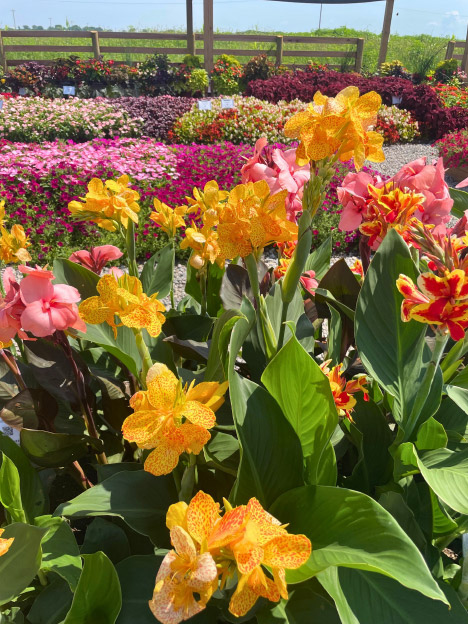
Unlike container-heavy trials in other parts of the country, Green Legacy planted directly into the ground using pop-up overhead irrigation to mimic real-world landscaping conditions.
“We were prioritizing mirroring what landscapers actually do,” Brill said.
This landscaper-first approach is rare in trial gardens, especially in the Midwest, where few trials exist outside of Michigan.
EMI’s involvement also sets this trial apart: the team regularly checks in with them to understand what metrics would actually be useful to the field.
“We have EMI to ask, ‘What metrics would be helpful for you to know from the trial garden? What kind of things do you want to see that would be beneficial for people in your industry?’” Brill said.
That collaboration underscored the garden’s purpose: not just to look good, but to deliver insights landscapers can use.
“Also being so close to Cultivate, one of the biggest events in the industry each year, is really helpful too,” Brill said.
Measuring and Seeing Performance
Brill’s work this first season centered on establishing the garden — only midseason did she begin capturing the plants’ performance.
“This first year, it was kind of a trial for us, too. We were learning so much, and we wanted it to look as gorgeous as possible. And data collection… we weren’t even considering it in the beginning,” Brill said.
Still, she started tracking performance on August 1st using a basic five-point scale. Each variety was scored for overall performance, resistance, uniformity, vegetative growth, and flowering. To do it, Brill printed spreadsheets, carried them into the field, and filled them out by hand.
“When I was going out there and rating each plant, I would print a spreadsheet out and just write it,” she said. “Especially because the [internet] service isn’t great. Paper and pencil is easiest.”
Plants that scored 4.6 or higher earned a spot in Green Legacy’s 2026 catalog.
One of the top performers was Ageratum ‘Monarch Magic’ — which Brill described as a “butterfly magnet.“
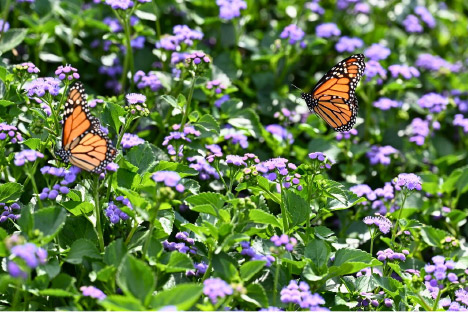
“I’ve seen over 50 butterflies on just the one plant,” she said. “It’s insane, and everybody who came to visit the trial garden mentioned it.”
Proven Winners’ Cleome and Helianthus also stood out, holding their color and performance longer than other comparable varieties, Brill noted.
PanAmerican Seed’s zinnias surprised her, too. “Zinnias are one of those flowers you see everywhere because they’re so easy to grow,” she said. “So, I didn’t think too much of it, but everybody was very impressed with them.”
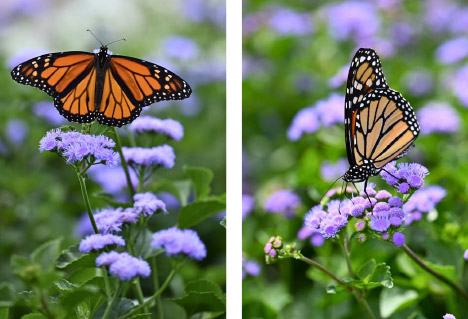
Brill’s personal favorite was the dwarf Buddleia called ‘Little Rockstars’ from Dümmen Orange. “It’s like a mini butterfly bush,” she said. “Usually, when I see mini butterfly bushes, they’re a little scraggly, but these were really compact and full. I was really pleased with those, too.”
What’s Next (And What They Hope to Achieve)
Feedback has already shaped next season’s approach. For starters, Brill plans to rate plants biweekly and expand metrics to include bloom time and pollinator activity. She’s also shopping for a data platform that would let Green Legacy share results live on their website.
“I’ve been asking about software and what other trial gardens use,” she said.
In pursuit of the perfect tool, she will attend the International Plant Trialing Conference in Minnesota next month, where there will be an entire session dedicated to digital data tracking.
“I’m going to that conference to hopefully learn about some kind of software, so that when I take data, I can immediately put it into the [system] and it’ll upload to our website so that it’s more of a public, ‘anybody can use this information’ kind of thing.”
The trial garden was always meant to be a resource, not just a display.
“The goal is to make this useful to as many people as possible,” she said.
Visitors — from landscape pros to curious passersby — are already taking notice. Some take notes. Others leave with ideas. And more than a few have walked away asking how they can start buying from Green Legacy.
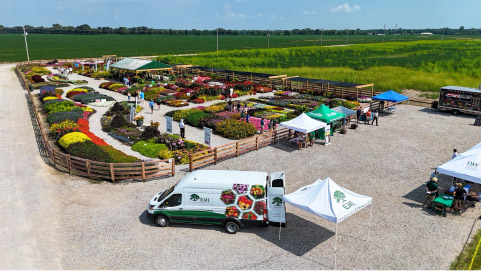
Plans are already in place to expand the trial garden to four acres, which triples its current size, with perennial beds added for multi-year trials.
But Brill emphasized that even with the eventual expansion, their mission remains the same: highlight new plant varieties and landscape performance, beautify the Midwest, and give decision-makers data they can trust.
“We want people to have access to the highest-performing plants,” she said. “And we hope to be one of their resources for figuring out what those are.”